 How-to
How to Protect Your Home With Professional Gutter Cleaning
Last Updated: October 28, 2026
Quick Summary
Professional gutter cleaning matters because clogged gutters send water into your roof, fascia, soffits, and foundation instead of away from the house. Keeping water moving through the downspouts prevents wood rot, soil erosion, basement flooding, and repairs that cost far more than a cleaning.
- Water backing up under shingles rots the fascia and soffits your gutters attach to.
- Overflowing gutters dump water at the foundation, causing erosion, cracked walls, and wet basements.
- Most homes need cleaning twice a year, in late spring and late fall.
- Mature hardwoods over the roofline often call for three to four cleanings a year.
- Crews flush each downspout to confirm water exits at the bottom, where most clogs hide.
Table of Contents
- Why Professional Gutter Cleaning Matters for Your Home
- Signs Gutters Need Cleaning You Should Not Ignore
- How Often to Clean Gutters Based on Trees and Climate
- The Professional Gutter Cleaning Process, Step by Step
- Gutter Cleaning Safety: Why DIY on a Ladder Is a Real Risk
- How to Choose a Gutter Cleaning Provider You Can Trust
- Get a Free Gutter Assessment From Fraley's Home Improvement
- Frequently Asked Questions
Why Professional Gutter Cleaning Matters for Your Home
Water is patient. It finds the weak spot in your roofline, the gap behind your fascia, the low corner of your foundation.
That is the case for why professional gutter cleaning matters. Your gutters are the one system on the house whose entire job is to move water away from the structure.
A homeowner skips a season or two of cleaning, and the next heavy rain finds the weak point.
What Clogged Gutters Do to Your Roof, Fascia, and Soffits
A clogged gutter turns into a standing pond along your roofline. That water backs up under the shingles and rots the wood behind the gutter.
The fascia is the board your gutter attaches to. The soffits are the panels under the eaves. Both sit right where backed-up water pools. Once that wood softens, gutters sag, pull loose, and stop doing their job entirely.
The damage is not always visible from the ground. If you suspect a problem, it is worth knowing how to spot water damage behind walls before it spreads. A roof inspection can catch fascia and soffit damage while it is still a repair rather than a replacement.
Foundation Erosion, Basement Flooding, and Costly Repairs
Here is the part most homeowners underestimate. Gutters that overflow dump water directly at the base of the house.
That soil erodes. The ground settles. Water pools against the foundation and finds its way in. Over time, you get a wet basement, cracked walls, and a repair bill that dwarfs anything a cleaning would have cost.
The fix is simple: keep water moving through the downspouts and away from the foundation. A clean, functioning gutter system diverts rainwater from the house. A clogged one pours it right at the wall.
Signs Gutters Need Cleaning You Should Not Ignore
The clearest sign is water spilling over the front edge during rain. If your gutters overflow while it is pouring, they are already blocked.
Other signals are easier to miss. Watch for these:
- Plants growing in the gutter. Seeds sprout in the debris. That is a sure sign of a long-standing clog.
- Sagging or pulling away from the roofline. The gutter is carrying weight it was never meant to hold.
- Stains or streaks on the siding below. Water is running down the exterior instead of through the downspout.
- Birds, insects, or pests nesting near the roofline. Standing water and debris attract them.
- Water pooling at the foundation after a storm.
- Visible granules from shingles in the gutter, a sign of roof wear.
If you notice sagging or a gutter that has pulled loose, cleaning alone may not solve it. At that point it is worth looking at gutter installation to replace failing sections before the next storm season.
How Often to Clean Gutters Based on Trees and Climate
For most homes, twice a year is the baseline: once in late spring after spring storms and seed drop, and once in late fall after the leaves come down. But that number is a starting point, not a rule, and the homes that get into trouble are usually the ones that treated it as one.
Use the factors below to move off the baseline and set a schedule that matches your lot.
Tree cover and species
- Mature hardwoods over the roofline (oak, maple, hickory): three to four cleanings a year is common, with the heaviest need in late fall and again after spring catkins and seed pods drop.
- Pines and other evergreens: needles are the problem, not leaves. They mat down, hold water, and are slow to break down, so a spring cleaning matters as much as a fall one. Two to three cleanings a year is typical.
- Few or no trees within falling distance: once annually can be enough, but the spring inspection still matters because shingle granules and windblown debris accumulate even on open lots.
- Trees close enough to touch the roof: treat this as a high-debris lot regardless of species. Branches over the roof drop continuously, not seasonally.
Seasonal debris calendar
Debris does not arrive on one schedule. A practical year looks like this:
- Early spring: clear winter accumulation, seed pods, and catkins; confirm downspouts survived freeze-thaw.
- Late spring / early summer: after heavy spring rains and the first pollen and seed drop.
- Late summer: windblown debris and any early leaf drop, especially in dry spells when trees shed.
- Late fall: the big one, after the majority of leaves have fallen, not before. Cleaning too early in fall means doing it twice.
Climate and storm exposure
Heavy spring rains and windy fall seasons push more debris into the system and stress the fasteners. Homes in areas that see frequent freeze-thaw cycles should get a late-fall cleaning so standing water does not freeze in the channel and back up under the shingles. Homes in high-wind corridors should check hangers after major storms, not just on the calendar.
Gutter type and roof pitch
- Wide, open gutters fill faster than covered or micro-mesh systems, but no cover is maintenance-free, covers still need the top surface cleared and the channel checked.
- Long, straight rooflines with few downspouts collect more per outlet and need more frequent flushing.
- Steep roof pitches shed debris faster into the gutter, which can mean more frequent cleanings but also faster overflow when blocked.
Use these factors to move off the twice-a-year baseline and set a schedule that matches your lot.
| Factor | Situation | Cleaning frequency |
|---|---|---|
| Tree cover | Mature hardwoods over the roofline | Three to four cleanings a year |
| Tree cover | Pines and other evergreens | Two to three cleanings a year |
| Tree cover | Few or no trees within falling distance | Once annually, with spring inspection |
| Tree cover | Trees close enough to touch the roof | High-debris lot regardless of species |
| Seasonal debris | Late fall | After majority of leaves have fallen |
| Climate | Frequent freeze-thaw cycles | Late-fall cleaning to prevent frozen water |
| Gutter type | Wide, open gutters | Fill faster than covered or micro-mesh systems |
| Roof pitch | Steep roof pitches | Shed debris faster, faster overflow when blocked |
The Professional Gutter Cleaning Process, Step by Step
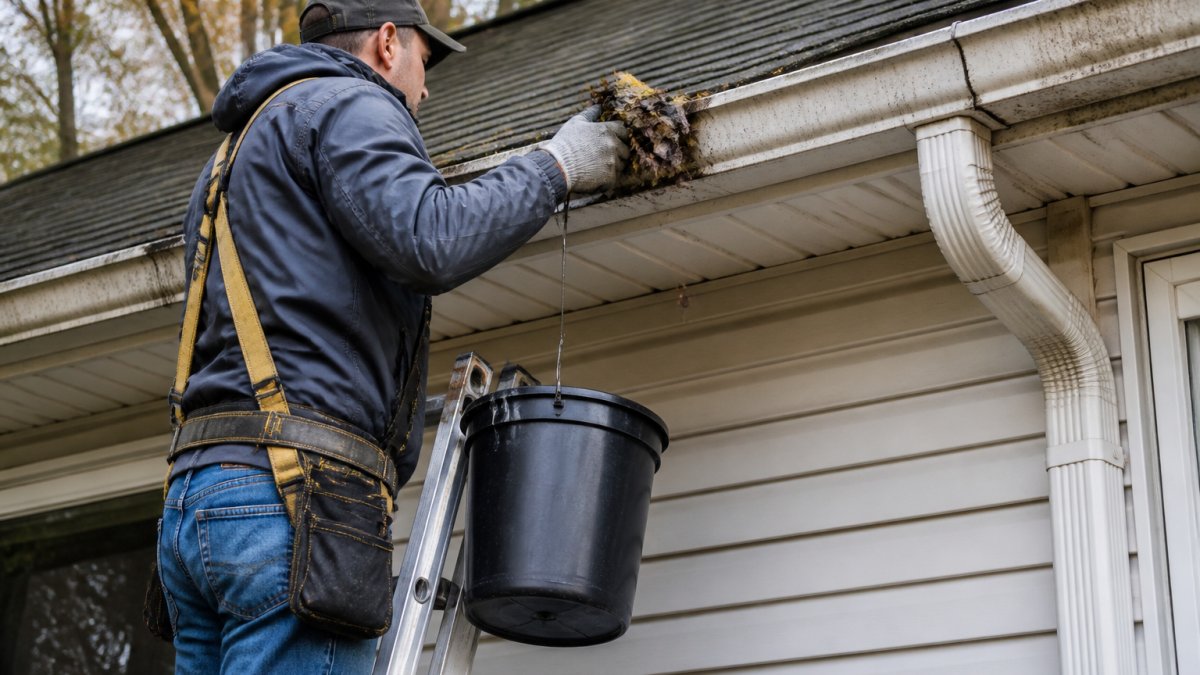
- Walk the perimeter and inspect from the ground first. Before anyone climbs, the crew checks the roofline for sagging sections, visible gaps between gutter and fascia, stains on siding, and downspouts that are disconnected or dumping too close to the foundation. This ground-level pass sets the work order and flags anything that needs a closer look.
- Set up safe access. Stable ladders with leg levelers on uneven ground, standoff stabilizers to keep the ladder off the gutter edge, and a bucket or bag hooked to the ladder rather than carried by hand. Crews working two-story rooflines often use gutter vacuums from the ground or low-slope stands to limit ladder time.
- Remove debris from the channel. Leaves, twigs, shingle granules, and compacted sludge come out by hand or with a scoop, working from the high end of the run toward the downspout outlet so loosened material moves in the direction of flow.
- Flush the system with water. A hose is run through each run to confirm water flow and to reveal low spots where water stands. Standing water after a flush is a slope problem, not a debris problem, and it needs to be noted.
- Clear and test the downspouts. This is where most clogs hide and where water drainage actually fails. Crews flush from the top and confirm water exits at the bottom, or use a plumber's snake or pressure hose for a stubborn block. A downspout that trickles instead of flows is still partially blocked.
- Check slope, fasteners, and seams. Gutters should tilt slightly toward the downspout, commonly cited as roughly a quarter inch of drop per ten feet of run. The crew checks hangers and spikes for pull-out, looks for separated seams and rust-through, and confirms the gutter is still attached to sound fascia.
- Confirm downspout discharge and extensions. Water leaving the downspout should be directed several feet away from the foundation, not dumped at the wall. Missing or short extensions are a common, inexpensive fix that prevents the foundation problems covered above.
- Document what was found. Photos of the before-and-after condition, notes on loose hangers, granule buildup, or early fascia softness, and a clear list of anything that needs repair versus anything that was simply cleaned.
Gutter Cleaning Safety: Why DIY on a Ladder Is a Real Risk
Falls from height can cause serious injuries (the CDC).
The risks stack up fast:
- Ladder placement on uneven or soft ground
- Reaching too far to skip moving the ladder
- Wet, slippery rungs and gutters
- Overhead power lines near the roofline
- No spotter if something goes wrong
For a two-story home or a steep roof pitch, DIY gutter maintenance is a gamble most homeowners should not take.
How to Choose a Gutter Cleaning Provider You Can Trust
Use this checklist before you hire:
- Ask for proof of insurance and licensing.
- Confirm they inspect the roof and fascia, not just the gutter channel.
- Request before-and-after photos of the work.
- Get a written, no-pressure estimate up front.
- Ask how they handle any damage they find, and whether that is a separate conversation.
- Check reviews and local reputation, not just a low price.
- Confirm they show up when they say they will.
Get a Free Gutter Assessment From Fraley's Home Improvement
Your gutters are doing their job right now, or they are not.
Fraley's Home Improvement has served homeowners for more than 55 years as a family-operated business. We offer free, no-pressure estimates. Our team is GAF Factory Certified and BBB A+ rated, with a 4.9 Google rating across 91+ reviews.
Get a free estimate and protect your home before the next storm finds the weak spot.
Frequently Asked Questions
Why is it important to clean gutters?
Gutters route rainwater away from your roof, siding, and foundation. When leaves and debris block them, water overflows and saturates fascia boards, soffits, and soil around the foundation. That leads to rot, mold growth, basement flooding, and erosion that can cost thousands to repair.
How often should gutters be professionally cleaned?
Most homes need cleaning at least twice a year, in spring and fall. Homes surrounded by heavy tree cover may need three or four visits, especially after fall leaf drop. In regions with frequent storms, checking after major weather events helps catch blockage early. A professional inspection can confirm whether your gutters need seasonal maintenance or a repair before the next rainy season arrives.
Is it safe to clean gutters yourself?
Falls from height cause serious injuries. If you are not comfortable on a ladder, avoid climbing it.
What should a professional gutter cleaning include?
A complete visit covers debris removal from the gutter channels, flushing the downspouts to confirm water flow, and checking hangers, seams, and fascia for damage. Crews should bag the debris rather than blow it into landscaping, and they should report any signs of overflow, sagging, or separation. Ask for a written summary of what was cleaned and any recommended repairs so you have a record for future maintenance.
Water damage rarely announces itself. It starts small, in a clogged downspout or a backed-up gutter, and grows into a repair you did not plan for. The good news is that a simple assessment catches most of it early. Fraley's Home Improvement brings 55+ years of experience, transparent pricing, and no-pressure estimates to every home we visit. Get started with Fraley's Home Improvement and keep water where it belongs: away from your home.